Published March 3, 2026
▶ Watch the full video
TL;DR
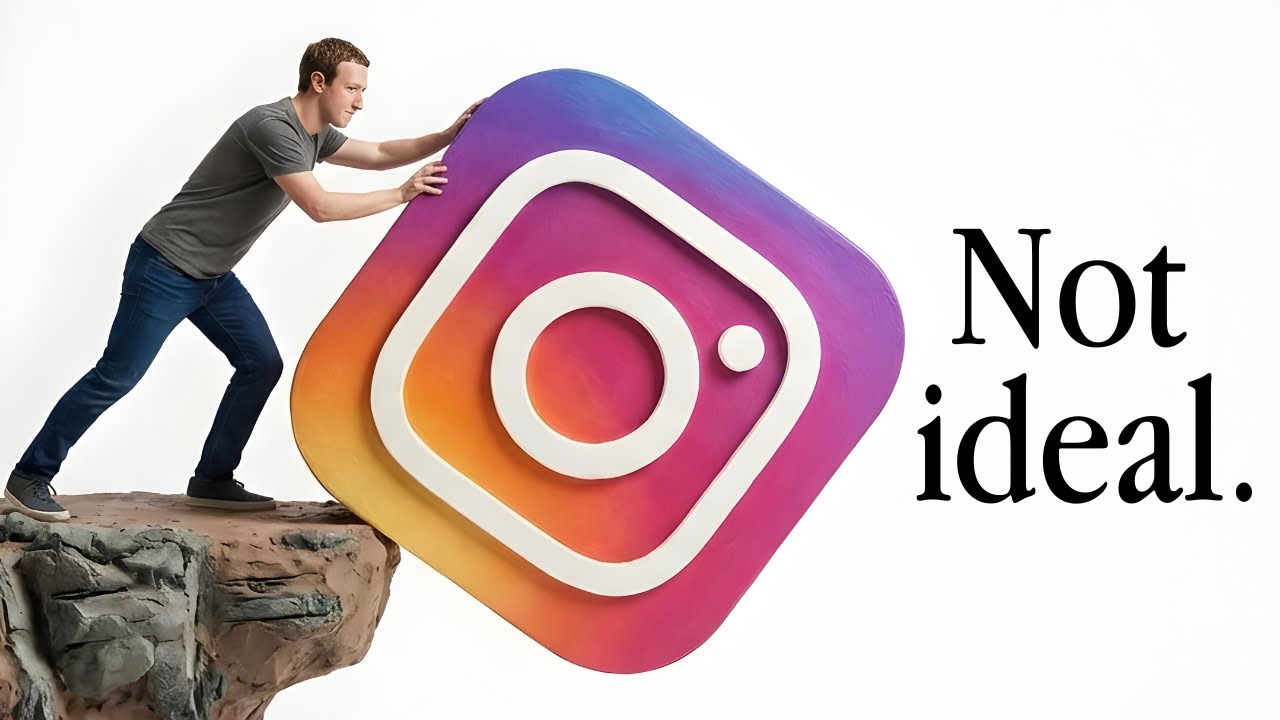
Everyone's Instagram reach has fallen off a cliff. It's not shadowbanning — it's a fundamental shift in how social media works. Here's the complete history of why, and exactly how to fix it.
Everyone's Instagram reach has fallen off a cliff. The TikTok dances and flash trends and trending audio that used to go turbo-viral are barely getting any views today. Your social media performance is in the gutter. No matter what you try, nothing seems to fix it.
This is not just you. This is an industry-wide problem at all levels. Even huge agencies are struggling. And it's not because you're shadowbanned. It's not because the algorithm hates you. It's because social media is undergoing a very dramatic change. If you do not recognize and adapt to that change, your performance on organic social is only going to continue to get worse.
The good news: the ability to fix it is 100% within your control. And when market conditions change, it creates huge opportunities for those who recognize and react quickly.
Before we get into the history, there are three core concepts you need to understand.
Three Foundational Concepts
1. Incumbency and Network Effects
An incumbent is the dominant player in a given market — typically the first player or inventor of their market category (think Tesla in electric cars). The longer a first player holds that monopoly, the harder it is to take it from them.
This is especially true in social media because it relies completely on user-generated content. More users = more content = more valuable platform. This is why Meta dominates — when they saw Instagram was where people were migrating, they bought it. Consumers go where creators are, and creators don't get to bring their followers to a new platform. It's why Threads and Bluesky are way smaller than X.
2. Novelty and Diminishing Returns
Humans are more interested in things that are new and exciting than things that are familiar. The first time someone on TikTok saw a hot girl in a bikini lip-syncing to a dance trend, it triggered a massive dopamine response. Eight years and 10,000 of those videos later, that same user requires something entirely different and more intense to achieve the same response.
This is true of anything involving the dopaminergic system — drugs, gambling, social media content. You need a bigger hit to get the same response. This is why the most consistently rewarded trait in marketing is the ability to innovate, not copy.
3. Experimentation and Audience Expectations
When a new form of media appears, nobody knows what "good" looks like. Early content is simple. Over time, audiences get sophisticated and the bar rises. The rate it rises depends on two factors: how many people consume the medium, and how easy it is to produce content for it.
Social media — especially short-form video — evolves extremely fast because it's both consumed and produced by a quarter of the planet's population daily. Audience expectations change on much shorter timelines than any medium before it.
The Four Generations of Social Media
Generation 1: Community-Based (2002-2013)
Social media as we know it started in 2002. Early platforms — Xanga, MySpace, even the original Instagram — were all community-based. You interacted with people you actually knew in real life. There was no algorithm. You saw posts from people you followed in chronological order.
Instagram's launch in 2010 didn't change this. It was just a cool way to share photos with people you already knew. The primary draw was the in-app photo editor with filters that made your phone photos look cooler.
Generation 2: Attention-Based (2013-2019)
In 2013, Vine came along — the first short-form video platform, allowing videos up to six seconds long. This is when things shifted from community-based to attention-based. Two reasons:
-
Video is naturally more interesting than images or text. The human brain is optimized for detecting and tracking movement. Video was always going to become the dominant social media format.
-
Humans are obsessed with fame. Vine democratized celebrity. If you were clever enough, your content could be seen by millions. The word "influencer" was literally coined during this era.
Vine went out of business in 2017 because — insanely — they couldn't figure out how to monetize 200 million monthly active users. TikTok immediately filled the void and exploded in 2018 after merging with Musical.ly.
Key trend to note: platforms kept making content creation easier. Instagram started with photo filters. Vine and TikTok embedded video editors. CapCut made editing free. The easier it is to create content, the more people create, the more consumers stay, the more advertisers spend. Flywheel.
Generation 2.5: The Attention Economy Evolves
TikTok had a three-year head start on Instagram Reels (which didn't launch until 2020). Three years in tech is a decade in any other industry. Zuckerberg got caught with his pants down.
People began to understand they could leverage social media attention for actual dollars. It was easier than ever in human history to become famous AND monetize that fame. Every person on Earth was one comedy skit, one lip sync, one meme away from becoming a legitimate global celebrity.
Generation 3: The COVID Boom (2019-2023)
COVID created perfect conditions for the explosion of OnlyFans:
- Entire world locked in their rooms with nowhere to go
- Massive government stimulus — 80% of all US dollars in circulation were printed between 2020-2021
- People were depressed, lonely, with oceans of free time and tons of disposable income
Short-form video was still relatively new, so basically everything being produced was novel. Nobody had a real sense for what "good" content looked like. Everything was equally exciting.
Instagram and TikTok competed ferociously for users, creating algorithms optimized for pure addiction. Users were psychologically vulnerable, had unlimited free time, and were happy to feast on the content equivalent of junk food.
You could not have engineered better conditions for OnlyFans if you actively tried. Everyone was bored, horny, flushed with cash, and indiscriminately consuming garbage content. The platforms rewarded trend followers almost as much as trend setters. If something worked for one creator, it would spawn a sea of copies that all performed nearly as well.
The easy money was never going to last forever.
Generation 4: Interest-Based (2024-Present)
By the end of 2023, the world was back to normal. The free money dried up. And here's the most important thing I'll say in this entire post:
Attention is subject to the same laws of supply and demand as every other good.
Attention is not infinite. When everyone went back to work, the overall units of attention in the economy shrank by roughly 8 hours per day times billions of people. That's a massive contraction. When people have less attention to spend, they're more discerning about what they spend it on.
Social media companies recognized this and adjusted their content delivery algorithms. They started using AI to analyze massive behavioral datasets to understand customer preferences at much higher resolution. The result: feeds are now personalized to each user's unique demonstrated interests.
You watch a video all the way through → system takes note → serves you similar content → tests different variations → within enough iterations, your feed is surgically tuned to what YOU specifically enjoy watching.
Why Your Old Strategy is Killing You
Most OFMs have an extremely outdated conception of "niche" that's held over from Generation 3. If you ask an agency what niche their creator is in, they'll say something like "goth" or "big boobs." These are incredibly broad, generic categories that are useless in the interest-based era.
This is why so many OFMs are struggling with dramatic reductions in reach. You look at creators like Sophie Rain, who built massive followings through looks and trends and TikTok dances, and you assume copying that playbook will get you the same results.
It won't. That type of content isn't even performing well for THOSE creators anymore.
I've proven this mathematically: on a pound-for-pound basis, Sophie Rain actually gets less reach than creators with less than a quarter of her following. She's only still successful because she became the incumbent when it was trivially easy to do so.
It's easy to win when it's impossible to lose. But it IS possible to lose now.
My most successful model from when I was managing regularly averaged over 1 million views per post and over 200 million impressions per month with just 500,000 followers. Today, that same creator has 1.2 million followers — over double — but averages under 100,000 views per post and under 20 million impressions per month. 10% of the performance with double the following. Same content strategy, different era.
How to Win in Generation 4
Once you acknowledge that things have changed, it's actually not that hard. And in my opinion, it's easier than ever to build a highly dedicated audience.
Pure Virality is No Longer the Goal
Rather than raw reach, the metric you should care about now is what I call niche saturation — the percentage of a niche's audience that you command the attention of.
The objective is no longer for every piece of content to reach as many people as possible. It's for every piece of content to reach precisely the right audience with surgical precision.
My YouTube channel is a perfect illustration. I only have 1,500 subscribers. But the total market for OFM content is probably 7,000-10,000 subscribers. That means I have 15-20% of the entire OFM content market. Despite that tiny following, I've built a functional business — consulting, production, courses — that I anticipate will clear well over seven figures this year, almost exclusively from leads generated by this channel.
That is the power of niche.
The Tara Framework: Who + How
I use a thought exercise with a fictional creator called Tara — an all-American country girl from Alabama who loves the outdoors.
Two questions drive every content strategy:
1. Who is my desired audience?
Specificity is everything. Just because Tara has big boobs, your target audience is NOT "men who like big boobs." That's an enormous, untargetable group.
Instead, think about what types of men would find Tara specifically irresistible if they met her in real life. Country boys. Men attracted to cowboy aesthetics, country music, hunting, fishing, rodeo. Blue-collar workers — tradesmen, construction workers, truckers.
Let's target long-haul semi-truck drivers: 98% male, lonely profession with few romantic opportunities, large disposable income with nobody to spend it on. Perfect OnlyFans audience.
2. How do I make content they actually want to watch?
Find the overlap between what resonates with your target audience and what content the model can create consistently.
Maybe Tara loves solo road trips and travel content. Truckers probably aren't interested in girly travel vlogs. But what about travel content for truckers? Reviewing gas stations and gas station snacks. Rating truck stops in every place she passes through. Content that lets Tara showcase her personality while providing legitimate value to truck drivers who are that much more likely to want to get to know her more intimately.
And Tara might be the only person creating this type of content — meaning maximum saturation with virtually no competition. There are over 2 million long-haul truckers in the US. If half use Instagram, that's over a million potential customers, all from one well-chosen niche.
Real-World Proof: Isa Moon
Perfect example: Isa Moon focuses almost exclusively on outdoors and fishing content. Result: millions of dollars and an extremely dedicated audience of 4 million people across five platforms, plus a successful OFTV game show.
She knows her lane. She stays in it. Multi-millionaire with a platform she could leverage for anything.
The Bottom Line
The near future of social media is increasingly specific content served to increasingly smaller niches. The trend is towards personalization — content for individuals, not mass markets.
The creators and agencies that continue to rerun the 2019-2023 generic slop playbook are going out of business. They're already going out of business.
The creators and agencies who do the deep work — analyzing what their audiences truly want, producing engaging creative for those audiences — are going to dominate this era.
The question is simple: which side do you want to be on?
📚 Join the course waitlist → 🆓 Free OFM resources → 💬 Join the Telegram community →